How Quack AI Governance Enhances Fast & Fair Web3 Decisions
I have been following Web3 projects for some time. One thing I find exciting is that some organizations can work without a boss. This is possible because of Decentralized Autonomous Organizations (DAOs). In a DAO, people who hold tokens make decisions together. This sounds fair, but many DAOs have trouble deciding things fast and fair.
A big problem is manual voting. When a DAO grows, only a few people vote sometimes less than 10%. This means a few big token holders, called “whales,” get too much power. Crypto markets move very fast. I have seen chances get missed because proposals take weeks to approve.
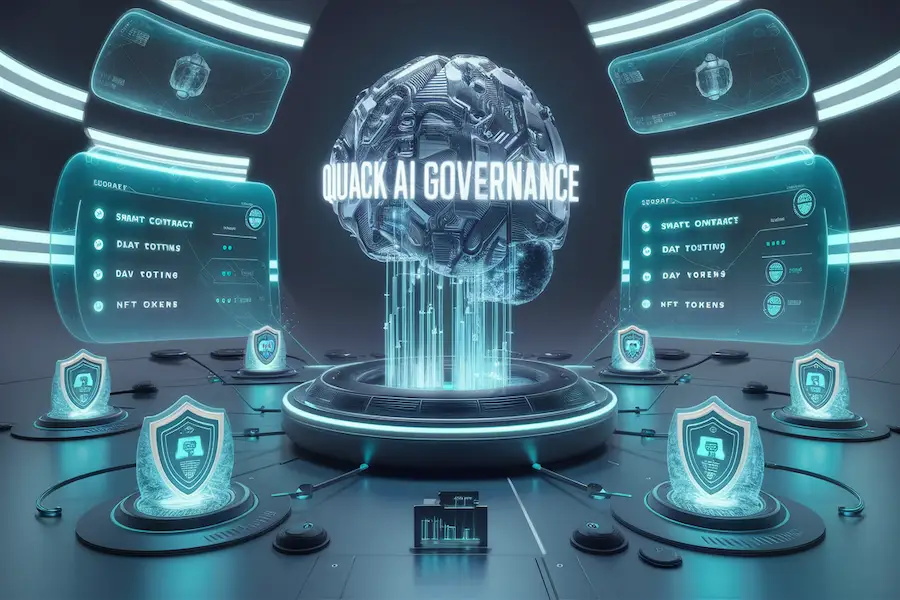
This is why Quack AI Governance is so helpful. It is the first AI system that helps DAOs make decisions automatically. Instead of waiting for slow human votes, Quack AI uses smart AI agents to act fast, fair and in real time. I have seen that it also helps smaller token holders have their voices heard.
With Quack AI, DAOs can act faster, stay fair, keep members involved and build trust because everything is clear. I think this is the future for any DAO that wants to grow and keep members confident.
What is Quack AI Governance?
In simple words, Quack AI Governance is a system where AI agents make DAO decisions automatically. It does not need humans to vote on every proposal. It uses data to make decisions that are fast, fair, clear and smart.
Its main advantages are:
- Speed: Decisions happen quickly, not in weeks.
- Fairness: Big token holders cannot control everything.
- Transparency: All actions are recorded on blockchain for everyone to see.
- Learning: The AI learns from past decisions and improves over time.
I like to think of Quack AI as a manager for my DAO. I have seen it read proposals, check risks see what the community wants and act instantly. This is very important in fast crypto markets.
Also, If you are wondering, “What is Quack AI coin?” or “What is Quackai DuckChain app?”, These are tools that connect with Quack AI to help manage DAOs better and track real-time prices.
How Quack AI Governance Works in Practice
Many DAOs have trouble approving proposals and taking action. Quack AI fixes this in three ways:
First: AI agents check every proposal carefully. They look at financial risks, operational problems, and security issues. This stops bad decisions from happening.
Second: AI reads community discussions and trends. It makes sure decisions match what token holders want. Normal voting often ignores small members, but Quack AI includes everyone.
Third: once a proposal is approved, AI agents act automatically. Smart contracts on Ethereum, Solana and Arbitrum do the work instantly. This stops delays and mistakes.
In short, Quack AI Governance works like a professional manager. It follows members’ wishes, stays fair and acts fast. If you care about both speed and fairness, I recommend it.
| Feature | Traditional DAO | Quack AI Governance |
|---|---|---|
| Decision Speed | Weeks | Real-time |
| Participation | <10% | High & Inclusive |
| Risk of Bias | High | Reduced with AI |
| Execution | Manual | Automated via Smart Contracts |
| Multi-chain | Difficult | Smooth across Ethereum, Solana, Arbitrum |
You may also ask, “How does Quack AI price work?” or “How does Quack AI CoinMarketCap listing affect the DAO?” These questions are natural when using Quack AI tools.
Challenges of Traditional DAO Governance
To understand why Quack AI is useful, we need to know the common DAO problems:
- Slow Decisions: Members read long proposals and vote. This can take weeks. Fast markets lose opportunities if decisions are slow.
- Voter Apathy: Many token holders don’t vote. Participation can fall below 10%. Decisions stall if people are tired or unsure.
- Plutocracy Risk: Big token holders (whales) can dominate votes. This is unfair.
- Bias & Emotions: Humans can be influenced by feelings or wrong info. Decisions can become unpredictable.
- Multi-Chain Issues: DAOs work on Ethereum, Solana and Arbitrum. Normal systems struggle to coordinate across chains.
From my view, Quack AI Governance solves all these problems. It automates decisions, reduces bias, ensures fairness and works across multiple blockchains.
How Quack AI Automates Decision Making
Quack AI does more than simple automation. Its AI agents make smart, multi step decisions with little human help. This is called agentic AI. It means AI can learn, adapt and act smartly.
One feature I like is the AI Delegation Model. Token holders can give their voting power to AI agents. It is like hiring a manager for your DAO. AI agents:
- Follow user preferences
- Check proposals quickly
- Make decisions automatically
- Keep members represented even when offline
This helps smaller token holders stay powerful and balances the power in the DAO.
Another feature is the Proposal Engine. It reads proposals, watches community talks, checks risks and tells AI agents what to do. Normal DAOs rarely use such data-driven methods.
After a proposal is approved, Quack AI acts automatically. It can release funds, give rewards, adjust tokens and run smart contracts. Acting fast like this reduces mistakes.
“How does Quack AI funding work?” or “What is Quack AI Token and how does it work?” These are important to know for anyone using the system.
Traditional DAO vs Quack AI Governance
I have noticed big differences:
Traditional DAOs:
- Decisions take weeks
- Less than 10% participation
- Big token holders dominate
- Actions are manual and error-prone
- Hard to work across multiple chains
Quack AI Governance:
- Decisions happen fast
- AI agents keep participation high
- Bias is reduced using data
- Tasks are automatic
- Works on Ethereum, Solana and Arbitrum
Any DAO that wants fairness and efficiency should use Quack AI Governance.
AI Agents: The Technology Behind Quack AI
AI agents are the brains of Quack AI. They make decisions for token holders.
I have seen them:
- Check community opinions to reflect what people want
- Look at financial, operational and security risks
- Watch market trends to see proposal effects
- Make reports to guide actions
- Act automatically using smart contracts
AI agents learn over time. They get better after seeing past decisions. This makes a system humans alone cannot match.
“How does Quack AI Reddit help track DAO decisions?” This is another way to see the community discussions and trends.
Key Features
I like Quack AI for these features:
- Multi-Chain Governance: Works on Ethereum, Solana, Arbitrum, DuckChain
- AI Voting Recommendations: Reduces bias and voter fatigue
- Smart Risk Checks: Checks risks automatically
- Governance Certificates: Members earn points for voting
- DeFi Management: AI handles treasury, liquidity and strategy
- Real-World Assets: Supports tokenized assets with audits
- Cross-Chain Coordination: Works smoothly across chains
- Transparent & Auditable: All actions recorded on blockchain
These features make Quack AI more than a tool. It is a full governance solution.
Real-World Applications of Quack AI
I have seen Quack AI used in many ways:
- DeFi DAOs: Manages treasury and liquidity
- NFT Communities: Helps with marketplace and rare trades
- DAO Grants & Funding: Approves projects faster
- Multi-Chain Projects: Coordinates decisions across Ethereum, Solana and Arbitrum
For example, I watched a DeFi DAO use Quack AI to allocate funds automatically. Decisions happened instantly. This shows AI governance works in real life.
Quack AI also connects to Quackai DuckChain app, Quack AI coin, Quack AI price, Quack AI Reddit, Quack AI CoinMarketCap, Quack AI funding, Quack AI Token, Quack AI airdrop and price prediction tools. I tried the app, and it is amazing to see how all these tools work together to make DAO management fair and simple.
Use Cases and Applications
We see Quack Ai Governance helping many parts of Web3 by guiding how AI supports people without taking control. I like how it keeps things balanced. It feels more like a smart helper instead of a boss.
One clear example is in DAOs. A DAO is a group where people vote to make decisions. Sometimes, there is too much information to read like market activity or new ideas. AI can read this data and share simple reports that help people vote with more confidence. With governance we know AI is following shared rules so the process stays fair and open.
Smart contracts also get real value from this. Smart contracts run by themselves but if something goes wrong fixing it is not always easy. AI can watch activity and warn people when something looks wrong. Of course not all contracts can be paused. Only the ones built with pause options can stop but Quack Ai Governance helps people act early so problems do not grow.
NFTs use this system too. NFTs show ownership of digital art, music or collectibles. AI can help check NFT details by comparing them with older records. AI cannot confirm full originality but it helps with early checks. In the end, we trust blockchain history and creator records the most because they show where something came from.
Decentralized identity (DID) also fits here. DID uses wallet addresses instead of ID cards. It helps users stay private though wallet activity may still be traced. Quack Ai Governance helps limit how data is used so people feel protected and not exposed.
Some places where quack Ai governance helps include DAO support, smart contract watching, risk alerts, NFT checks, identity care and market study.
Real Examples
Let’s take a simple example. A DAO needs to choose a new project but there is a lot of information. AI reads the data and gives a short summary. Members understand better and vote with more clarity. I’ve seen this make a big difference because it saves time and avoids confusion.
Another example is when a new NFT appears. AI checks its details and matches them with past records. When communities stay active and support each other, Quack AI Governance grows stronger, keeping Web3 systems fair and trusted.
Sometimes, A smart contract shows unusual token movement. AI sends an alert. If the contract was built with a pause button people stop it and fix the problem early. Tools like quackai and duckchain help store proof records that show what happened and I think that builds trust quickly.
Trust, Transparency and Security
Web3 is open and that is why people want to understand how AI makes choices. I like that quack Ai governance keeps short notes about how AI was trained and updated. Anyone can review these later which builds trust.
Even if someone does not know every detail they can still understand why a decision was made. This is helpful inside DAOs where members vote on big actions. When rules are clear, I feel more comfortable trusting the system.
Security is very important too. Web3 systems store tokens, NFTs and wallet data. A small mistake could lead to loss and nobody wants that. Quack Ai governance helps limit what AI can access and suggests regular checks so humans stay in control. I think this balance makes the system safer and easier to use.
Key Parts of the Quack AI System
The main parts of this system include model history notes, tools for community approval, data access rules and risk reports. These pieces work together to help confirm that AI follows shared rules and stays fair.
Quack AI App and Pricing
The Quack AI Governance app helps teams manage AI in simple ways. It records when rules change and who approved them. DAOs like this because many people can take part and learn from the updates. I think this makes decisions easier to trust.
Access is given through wallet identity. Some users receive roles through voting or token ownership. This adds privacy, though wallet identity can still be traced so limits help keep people safe.
The app sends alerts when AI acts in unusual ways so teams can fix problems early. This keeps things under control and avoids sudden damage.
Pricing depends on team size and needs. Small teams can start with basic tools and grow later. Larger teams can use more features when ready. These price notes are only examples not final numbers.
Some main parts of the app include rule control, clear data use, wallet based access lines, risk alerts and helpful reports.
Technical Structure
The system is built around three main parts.
The first is the rule zone, where rules are created.
The second is model notes, which store versions of AI models.
The third is the monitor, which checks how AI acts.
Tools like quackai and duckchain help store proof on blockchain so people can trust the records. Full records stay off chain to keep privacy safe. I think this setup is smart because it mixes safety with easy access.
Benefits Over Traditional Governance
Older governance systems move slowly because they were designed for older business models. Web3 moves fast with smart contracts and quick markets. Quack Ai Governance matches this speed and helps people keep up.
Fairness is a strong benefit. AI can make uneven choices sometimes. Governance checks for this and keeps records so no one can secretly change a model. This helps build long term trust which is important in Web3.
Another helpful part is that it can grow easily. When more models join Web3, teams can add new tools and still stay in control. This makes the system useful even as things get bigger.
| Benefit | Traditional DAO | Quack AI Governance |
|---|---|---|
| Decision Speed | Slow, weeks | Instant, real-time |
| Fairness | Dominated by whales | AI ensures balanced power |
| Errors & Bias | High | Reduced via AI analytics |
| Multi-chain Support | Limited | Full support: Ethereum, Solana, Arbitrum |
| Community Engagement | Low | High, AI keeps members involved |
Quack AI ensures fairness, scalability, and efficiency, essential for fast moving Web3 environments.
Integration with Web3 Tools
Quack Ai Governance connects with smart contracts, wallets and dApps. This helps teams manage tasks from one place. When systems feel connected, I notice people work faster and make decisions more easily.
Privacy and User Rights
Privacy matters to everyone. Quack Ai Governance protects user data by limiting what AI can access. On chain data cannot be deleted but off chain data can be removed or blocked. This keeps people in control of their information and that feels comforting.
Industry Use
Many industries benefit when AI is guided safely.
In healthcare, AI can help read medical data. Governance keeps data safe though hospitals still must follow medical laws.
In finance, AI can watch markets. Governance helps keep things fair but banks must follow local rules.
In real estate, AI can help estimate property value and Quack AI Governance keeps the process open so people can trust the result.
Metrics to Watch
Teams can watch how correct AI is, If rules were followed and how many alerts were sent. These are simple ways to check if the model is doing well.
Community Role
The Web3 community plays a strong role. People can vote on rules check model updates and share ideas. This helps keep everything fair and clear. I like that users are part of the process not just watching from outside.
Roadmap and Future Growth
In the future, Quack Ai Governance may work across many blockchains. This will help keep rules the same everywhere. It may also add badges that show which models passed safety checks.
Some tools may suggest ways to fix bias but humans will still approve these changes. One day, teams may share rule sets through a simple marketplace making setup easier for everyone.
Challenges and Solutions
Teams must learn both AI and blockchain to use governance well. Training helps people gain confidence.
Costs may grow as teams expand. Groups can start small and upgrade later so money is not wasted.
Older systems may be hard to connect. Planning early helps avoid delays.
Communities must stay active. When people work together, Quack AI Governance becomes stronger and more useful for everyone.
Also Read: Online Tool Guide Zardgadjets – Work Smarter Today
FAQs
What is quack Ai governance?
Quack Ai governance is a rule system that helps guide how AI works in Web3. It makes sure AI follows shared rules so users stay safe and in control.
Why do we need quack ai governance in Web3?
Web3 is open and fast. Without rules, AI could make unfair choices or put user data at risk. Governance keeps AI fair, clear and safe.
Who uses quack ai governance?
DAOs, DeFi apps, NFT teams and many other Web3 projects use it. Anyone who wants safe AI in Web3 can use it.
Can quack ai governance stop smart contract mistakes?
It cannot fix everything. It warns users about risky activity. Only contracts built with a pause button can stop. Governance helps teams act early.
Does it work on multiple blockchains?
Yes, Ethereum, Solana, Arbitrum, and DuckChain are supported.
Conclusion
Web3 and AI bring new ideas and tools that help people build strong and fair systems. But AI needs rules to protect privacy and avoid unfair actions. Quack Ai governance gives these rules and helps AI stay safe. This builds trust and gives users a clear and comfortable experience.
Systems like quackai and duckchain help store proof so users trust decisions. Many new builders grow faster when they use governance early and I think that is a smart path for anyone building in Web3.
For related tech details, check this Finalites