Discover Cesta Roman: Ancient Roman Combat Gear Revealed
If you are looking for a clear and simple explanation of cesta roman here is the short answer first. They refers to an ancient Roman system of roads that helped people travel trade and communicate efficiently across long distances. Understanding it helps you see how planning connection and structure can shape strong societies even today.
This article explains cesta roman in easy English with real meaning practical lessons and honest opinions. By the end you will understand why it still matters in real life.
What Is Cesta Roman and Why It Matters
Cesta roman was the organized road network built by the Romans to connect cities, towns, military camps and trade centers. These roads were carefully planned and built to last for many years. Unlike simple paths they followed rules measurements and strong building methods.
The Romans believed that strong connections create strong control safety and growth. This idea still applies today when we talk about transport systems internet networks or even school planning.
Why This Ancient Combat Gear Was Made to Last
One of the most impressive things about cesta roman is how strong the roads were. Roman engineers did not just place stones randomly. They layered materials like sand gravel and stone in a fixed order to make the road stable.
Because of this method many parts of cesta roman still exist today. When I first learned this, I was surprised that roads built over two thousand years ago could survive longer than some modern roads. This shows the power of careful planning and patience.
The Purpose Behind Cesta Roman Roads
• Main goal was control and movement
• Provided fast routes for Roman armies to move soldiers
• Offered safe paths for traders to carry goods
• Enabled messengers to deliver information reliably
• Showed that systems should solve real problems
• Built roads to make life easier and more organized
• Demonstrated a practical mindset we can learn from today
How This Fighting Gear Fit Into Roman Daily Culture
When I think about this it reminds me of how modern highways or metro stations change city life. In the same way cesta roman shaped where people lived worked and met others. Roads were not just paths they were part of daily life.
Cesta Roman and Its Influence on Trade Networks
Cesta roman was not only used in traveling it had a massive contribution to trade. These roads were used by merchants in the transportation of goods such as food tools, wine and cloth in one city to another. With the good and stable roads construction goods were no longer lost on their way to their destinations as it used to take less time. This enabled the Roman economy to grow as traders were able to expand their markets and sell to the distant places.
This has been the case with me in school whenever I worked on a group project. The existence of a clear path and order of plan made the project successful just as the Roman roads made trade successful.
A Symbol of Cultural Exchange in the Ancient World
Cesta roman allowed the people to exchange ideas and culture throughout the Roman Empire. Traders, soldiers and travelers transferred through the roads and as a result, they shared languages, customs and traditions. This aided in giving a feeling of unity to different regions.
This interests me personally since it demonstrates that roads are more than simply transporters of people and they transmit knowledge and culture. Indicatively through traveling or meeting new people in school we can learn new ideas. This was on a massive scale among the Romans.
The festivals, religious and performances also spread with ease thanks to these roads. Artists, scholars and philosophers were able to access new cities.
Care, Maintenance and Long Term Durability
The longevity of cesta roman roads was due to the fact that Romans continued to take care of them on a regular basis. Authorities checked highways, fixed the places of destruction, and ensured that commuters could use them safely. This maintenance system played a major role in maintaining the efficiency in trade, communication and military movement.
In my opinion, this forms a very good lesson it is not enough to create something but to take care of it is also important. In life, be it in a school project, a garden or a skill, one would constantly take up attention and it will remain to work out.
The design was also a contributing factor to longevity. The roads were slightly elevated in the center to drain water and they were made of durable material.
How Ancient Engineering Compares to Today’s Roads
Understanding cesta roman becomes much easier when we compare it with modern roads. Both were built to help people travel, trade and stay connected. However, the tools, materials and goals behind them were different. This comparison helps students see how ideas from the past still influence the present.
When I look at this comparison, I feel that modern systems did not start from zero. Many basic ideas we use today came from Roman thinking. Seeing both side by side makes history feel practical instead of distant.
| Feature | Cesta Roman | Modern Roads |
| Time period | Built over 2000 years ago | Built in recent centuries |
| Main materials | Stone, gravel, sand | Asphalt, concrete |
| Tools used | Hand tools and manual labor | Machines and advanced technology |
| Purpose | Travel, trade, military movement | Travel, trade, daily transport |
| Durability | Extremely long lasting | Depends on maintenance |
| Planning style | Long term and structured | Often short term and budget-based |
This table shows that while technology has changed, the basic need for strong and reliable roads has stayed the same. It also explains why Roman road ideas are still respected today.
Structural Planning and Construction Techniques
Cesta roman was designed in an advanced manner. Roman engineers could plan every road taking into account a topography, climate and its use in the future. To ensure durability of roads, they were covered with sand, gravel and stone. Engineers still managed to find ways of remaining straight and dependable when passing through hills and rivers.
I like this since it demonstrates the need to focus on detail and solve a problem in a lasting manner. I also see that once I start myself planning my own tasks, I stop making mistakes. The Romans transferred the same principle to roads and made a system that was centuries old.
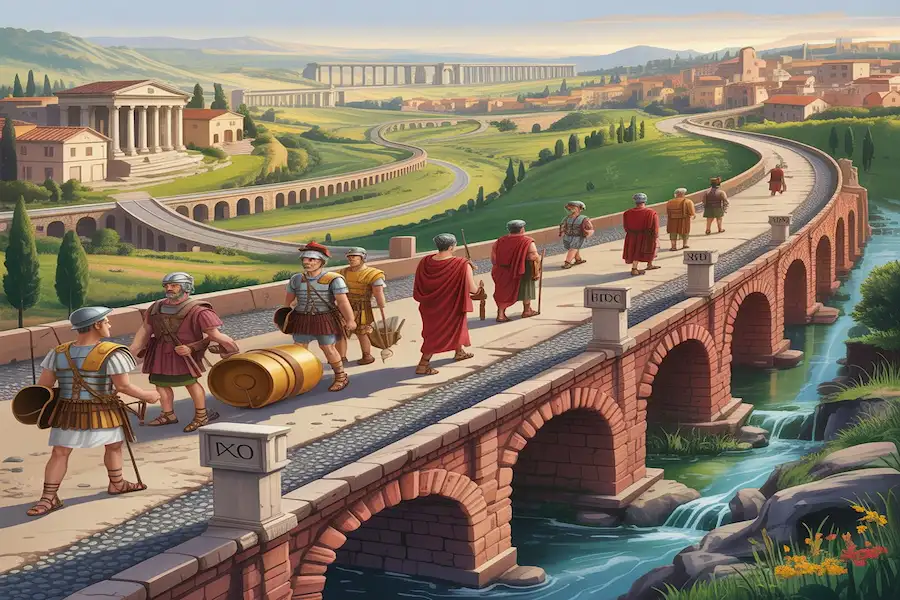
Bridges, drainage systems and milestones were also part to direct the travelers. These characteristics made the roads safer as well as convenient.
Military Importance of Cesta Roman
• Cesta roman was very important for the Roman army
• Provided fast and safe roads for soldiers to travel across the empire
• Allowed armies to reach threats quickly
• Helped transport supplies to camps efficiently
• Made moving equipment easier
• Prevented delays and problems for military operations
• Roads were built to carry heavy loads and many soldiers
• Milestones marked distances for travelers and soldiers
• Many roads were straight, allowing soldiers to march in order
• Showed that good planning improves results and safety
• Demonstrates how roads support trade, travel and defense
Technical Genius of Ancient Roman Builders
Roman engineers were highly skilled. They measured land carefully and chose routes that avoided floods and weak soil. Even when crossing hills, cesta roman roads were designed to stay straight whenever possible.
This attention to detail inspires me personally. It shows that doing something the right way, even if it takes longer, creates better results. The Romans did not rush their work and that patience paid off.
Ancient Routes Compared to Modern Road Systems
When we compare cesta roman to modern roads, some differences are clear. Modern roads use machines and technology, while Roman roads depended on human skill and planning. However, the basic idea of layers and strong foundations is still used today.
In my opinion, cesta roman proves that good ideas never become old. Even with advanced tools, engineers still follow principles first used by the Romans. This connection between past and present makes the topic very meaningful.
Role in Everyday Life in Ancient Rome
Cesta roman was one of the aspects of life in ancient Rome. These roads were used by farmers, traders, families and travelers. The settlements along the roads developed into the centers of the business and social life, into villages and towns.
I consider this interesting as it demonstrates the influence of road on the every day life. We go to school, meet friends or run errands today with streets and transport systems that assist us to reach our destinations.
Festivals and markets were also accessible owing to the roads. Stores and hotels were found on the roads to assist travelers.
Read This: UpTheSwitchLLC Review: Is It Safe & Legit in 2025 Today?
How It Shaped Society and Traditions
Cesta roman helped spread Roman culture across the empire. As people traveled, they shared traditions, language and knowledge. This helped connect faraway regions and encouraged people to learn from each other.
I like this part because it shows that roads do more than move people they move ideas. Just like we share ideas in school or online, cesta roman allowed communities to exchange knowledge.
The roads also let scholars, artists and performers travel to new cities. Festivals and cultural events could reach more places.
Engineering Breakthroughs of the Roman Era
Cesta roman was an excellent work of engineering. Roads were constructed by Romans in layers with the help of sand, gravel and rocks. They also included bridges, drainage and signs to ensure that there is improved safety in traveling. These designs contributed to the longevity of the roads to hundreds of years.
In my personal opinion, this demonstrates the importance of being creative and practical at the same time. I achieve better outcomes when I think over my projects.
They thoroughly designed slopes, width of roads and material in such a manner that all soldiers, traders as well as travelers could use the roads.
What Modern Society Can Learn From Roman Innovations
One lesson from cesta roman is the value of long term thinking. The Romans built roads knowing they would be used for generations. They did not focus only on short term benefit.
Another lesson is responsibility. These roads were public systems meant to help everyone. When I think about writing this article, my purpose is to show readers that learning from history can improve how we plan our own lives and communities.
How Ancient Practices Boosted Commerce
Cesta roman played a very important role in trade. Merchants used these roads to move goods like grain, wine, olive oil and tools from one place to another. Because the roads were reliable, trade became faster and safer.
In my opinion, It was one of the biggest reasons the Roman economy stayed strong for so long. When people can move goods easily, businesses grow. Even today, strong road systems help countries grow economically.
How Cesta Roman Helped Spread Culture and Ideas
Cesta roman transported goods beyond transportation. It facilitated the dissemination of language, traditions and thoughts. The traveling people exchanged tales, ideologies and abilities. This brought the various regions into commonality.
Through this part of cesta roman I like myself the most. It reminds me that bonding brings about insight. The interaction of people leads to learning and development. This was possibly not the intention of the Romans but a strong by product of their roads.
Tactical Uses in Ancient Roman Armies
The Roman army depended heavily on cesta roman. Soldiers could move quickly to protect borders or respond to danger. Roads were built wide enough for troops and supplies.
This shows that cesta roman was not random. It was part of a larger plan. From my perspective this teaches us that planning systems with clear goals helps avoid confusion and delays.
Maintenance and Rules of Roads
Romans did not just build roads and forget them. It was maintained regularly. Officials were responsible for repairs and rules were set for usage.
I believe this is a lesson we often ignore today. Building something is not enough. Taking care of it matters just as much.
Why Many Roads Still Exist Today
Many paths we use today are built over old cesta roman routes. Their strong foundations made this possible. Engineers found it easier to improve existing roads than start from scratch.
This fact always amazes me. It proves that smart work saves future effort. When we build things properly today, future generations benefit.
Misunderstandings About Cesta
Some people think cesta roman was only for rich people or rulers. This is incorrect. These roads were used by farmers, workers, travelers and families.
Another misunderstanding is that Roman roads were simple stone paths. In reality, cesta roman followed advanced construction methods. Clearing these misunderstandings helps readers truly understand history.
Why I Wrote This Article
I wrote this article because many students see history as boring or useless. I disagree with that idea. Topics like cesta roman show how history connects directly to real life.
My goal was to explain in a friendly way so readers feel confident not confused. I wanted this article to solve the problem of hard language and missing explanations.
Why I Recommend Learning About Cesta Roman Today
I strongly recommend learning about cesta roman because it builds thinking skills. It helps you understand planning, responsibility and long term vision.
From my experience, once you understand how systems work in history, you start noticing them everywhere around you. Roads, schools and even online platforms follow similar ideas.
Read This: Nerwey Explained: What It Is, How It Helps Daily Life & Simple Uses
FAQs
What does cesta roman mean?
Cesta roman refers to the road network built by the Romans to connect their empire.
Why was cesta roman important?
No, They spread across Europe, parts of Asia and Africa.
How long did cesta roman roads last?
Many lasted for centuries and some routes are still used today.
Can we learn anything from cesta roman today?
Yes, It teaches planning, durability and the importance of strong systems.
Conclusion
Cesta roman was more than a road system. It was a smart solution to real problems. It connected people, supported trade, strengthened defense and shaped daily life. Even after many centuries, its impact is still visible.
By learning from it, students and readers can understand that good ideas never lose value. History becomes meaningful when we see how it still guides us today.
building and planning made the Roman Empire safer. Learning about the military use shows how roads can help not only trade and travel but also defense and safety.